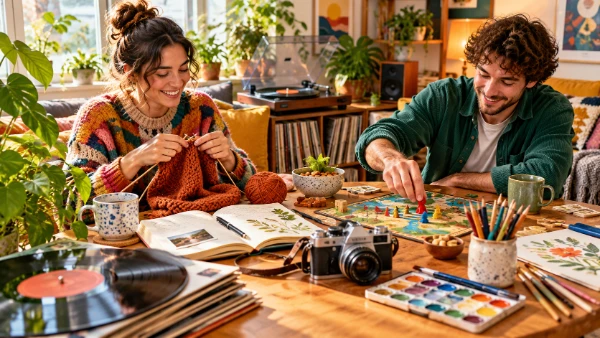
For years, leisure time seemed to be moving in one direction: towards more screens, more apps, faster entertainment and an almost unlimited supply of content. In 2026, that direction is becoming less straightforward. Knitting, crochet, journalling, board games, vinyl records, film photography, drawing, gardening, model making and other hands-on pastimes are receiving renewed attention, including from people who grew up with smartphones rather than before them. The shift does not mean that people are abandoning technology or attempting to recreate life in an earlier decade. What many appear to want is a different kind of free time: an activity with a beginning and an end, something they can touch, make, keep or share, and a period in which their attention is not being repeatedly redirected. Current British data helps explain the change. Adults in the UK were already spending an average of four and a half hours online each day in 2025, while younger adults spent considerably longer. Against that background, an evening spent shaping clay, completing a jigsaw, tending a garden or playing a board game can feel less like nostalgia and more like a deliberate change of pace.
Why Constant Connection Is Creating Demand for Slower Leisure
The renewed interest in analogue hobbies makes more sense when it is placed beside the amount of time people now spend connected. Ofcom’s Online Nation 2025 report found that UK adults spent an average of four hours and 30 minutes online each day on personal smartphones, tablets and computers in May 2025, ten minutes more than a year earlier. Among 18- to 24-year-olds, the average reached six hours and 20 minutes. Smartphones accounted for most of that time, and the average adult smartphone user used 41 apps during the month. Being online is obviously not one single activity: those hours can include messaging family members, reading the news, watching films, managing finances, studying and arranging everyday life. Even so, leisure increasingly takes place on the same device used for work, administration, notifications and social feeds. The boundaries between useful screen time and habitual screen time can therefore become difficult to notice, particularly when a few intended minutes of checking messages turn into a much longer sequence of unrelated content.
There is also evidence that many people are actively questioning that pattern rather than simply accepting it. EY’s survey of 2,500 UK consumers, published in 2025, found that 38% were concerned about excessive screen time and were interested in a digital detox. Among people aged 18 to 34, 47% said their online activities could be more disruptive than beneficial to their wellbeing. A separate 2025 survey by the Institute of Practitioners in Advertising and Opinium found that 47% of British adults intended to reduce their screen use over the Christmas period, rising to 64% among Gen Z respondents and 57% among Millennials. These figures should not be read as proof that most people want to give up their phones. They point instead to a growing wish for boundaries. People still value the convenience and entertainment of connected life, while increasingly looking for periods in which they are not expected to check, respond, refresh or keep up.
Analogue hobbies fit that need because they organise attention differently. A social feed has no natural finishing point: there is always another post, clip, recommendation or update. A physical activity generally gives the brain something more definite to work towards. A row of knitting can be finished. A chess match ends. A sketch reaches a stage where the pencil can be put down. A chapter has a final page, a jigsaw has a final piece and a plant produces visible growth over weeks rather than another update seconds later. This does not automatically make every traditional pastime relaxing, and hobbies can certainly become frustrating or demanding. Their value lies partly in the fact that the activity itself sets the pace. Progress is connected to what a person does with their hands, attention or skill rather than to the speed at which new material arrives. For someone accustomed to rapidly changing information, that slower rhythm can make an ordinary hour feel noticeably different.
The Appeal Is Not Nostalgia Alone
It is tempting to explain the trend entirely through nostalgia, but that misses an important part of what is happening in 2026. Many of the people taking up crochet, board games, fountain pens or vinyl records have little or no personal memory of a time when those things were the default. A 20-year-old buying an LP is not necessarily attempting to recreate the 1970s, just as a young adult learning embroidery is not trying to reproduce a grandparent’s lifestyle. Recent academic work on adult board gaming in Britain has made a similar point. Research published in 2026 by Alexandra Kviat examined how physical and connected habits now exist alongside one another rather than as simple opposites. Someone might hear about a board game through a video, arrange a game night through a messaging app and buy a second-hand copy online, yet still value the two hours spent around a table precisely because those two hours feel different from ordinary screen use.
What changes is the texture of attention. Hands-on hobbies ask a person to deal with material that cannot instantly be swiped away. Clay resists. Yarn tangles. Seeds take time to germinate. Paint needs to dry. A difficult passage of music needs to be played more than once. Even a relatively simple activity such as assembling a jigsaw requires the eye to stay with small differences in shape, colour and pattern. That can feel unusually satisfying after leisure built around rapid switching. The point is not that slow attention is morally superior to fast entertainment. A short video can be funny, useful or genuinely memorable. The difference is that analogue hobbies create conditions in which staying with one thing is part of the activity rather than an act of self-discipline. The hobby gives attention somewhere to go, which is often easier than sitting beside a phone and repeatedly trying not to pick it up.
Physical hobbies also involve senses that a screen uses only partially. The weight of a record sleeve, the smell of a book, the texture of paper, the sound of scissors through card, the feel of soil or wool and the small imperfections of handmade objects all contribute to the experience. These details matter because leisure is not only about receiving information. It can also be about movement, touch, rhythm and memory. A handwritten diary page can bring back the circumstances in which it was written; a repaired jacket carries evidence of the repair; a box of photographs accumulates marks and annotations that become part of its history. Digital files can carry powerful memories too, but physical objects occupy space and change through use. For some people, that material continuity is precisely what feels valuable after years in which much of daily life has become quick to access, easy to duplicate and just as easy to forget.
Making, Collecting and Reading Give Progress a Physical Form
Craft is one of the clearest parts of the analogue revival because it combines concentration with an obvious result. Knitting, crochet, sewing, embroidery, pottery, woodworking and paper crafts all turn time into an object that can be seen and handled. They also allow beginners to start with modest projects rather than needing professional-level skill. Evidence from a representative 2025 survey of 1,004 adults in Germany who knitted or crocheted at least occasionally gives some indication of how these activities fit into ordinary routines. More than half practised at least weekly, while roughly 45% did so several times a week or every day. Relaxation and stress relief were the leading motivations, rather than saving money. That distinction is useful. Handmade clothes or decorations are not automatically cheaper than mass-produced alternatives once materials and time are taken into account. Their attraction often lies elsewhere: learning a technique, concentrating on repeated movements and ending a session with visible evidence that something has changed because of the time invested.
Research on wellbeing gives some support to that everyday experience, although the evidence should not be exaggerated. An analysis of data from 7,182 adults in England found an association between participation in arts and crafts and higher reported happiness, life satisfaction and a stronger sense that life was worthwhile, after taking several demographic factors into account. A systematic review published in 2025 examined 19 studies of craft-based interventions and found a varied body of evidence rather than a simple guarantee of benefit. That is an important distinction: knitting or pottery should not be treated as a substitute for professional care when somebody needs it. What the research does support is a more measured idea. Creative hobbies can provide structured activity, opportunities to learn, a sense of competence and, in group settings, contact with other people. A 2025 University of York study of outdoor heritage crafting also reported promising changes in social connectedness among its small group of participants, while stressing the need for further research.
Collecting and reading show that the appeal of physical objects extends beyond craft. In the UK, vinyl sales rose by 13.3% in 2025 to 7.6 million units, according to BPI analysis, marking an eighteenth consecutive year of growth. That is particularly striking because listeners have immediate access to enormous music catalogues through streaming services. Buying a record therefore serves a different purpose from simply obtaining access to a song. The sleeve, artwork, sequence of tracks and act of putting a record on can turn listening into a chosen activity rather than background sound. Printed books remain substantial too. NielsenIQ BookData reported that around 191 million print books were purchased in the UK in 2025. That represented a 2% fall in volume from 2024 rather than growth, so it would be misleading to describe every physical medium as booming. Yet the scale is significant: even with e-books and audiobooks readily available, British consumers still bought hundreds of millions of objects made of paper, ink and card.
Why Small Imperfections Now Add Value
One attraction of making something by hand is that the finished object does not have to look mechanically identical to everybody else’s. A slightly uneven stitch, a hand-thrown cup that is not perfectly symmetrical or a notebook filled with crossed-out sentences can carry evidence of the person who made or used it. That is a different form of value from technical perfection. The current craft revival also overlaps with repair and reuse. Sewing on a button, altering second-hand clothes, learning visible mending or turning leftover paper into a journal can extend the life of objects while teaching practical skills. These activities are not automatically sustainable simply because they are handmade; buying large quantities of new craft supplies can create its own waste. The more convincing environmental benefit comes when a hobby encourages maintenance, reuse or thoughtful consumption. A sewing kit used for years or a piece of furniture repaired rather than replaced has a clear practical function as well as a creative one.
Paper-based hobbies offer another form of physical continuity. Journalling, scrapbooking, letter writing and keeping recipe books have all gained renewed attention because they produce records that belong to the person making them. A paper journal does not issue notifications halfway through a sentence. A scrapbook can contain a train ticket, a restaurant receipt, a pressed leaf or a handwritten note without requiring those fragments to be presented to an audience. In 2026, London’s renewed interest in specialist stationery has included fountain pens, planners, notebooks, stickers and paper designed for journalling. Part of the appeal is aesthetic, but there is a functional reason too. Writing or arranging material on paper creates a limited physical space. A page fills up. A notebook eventually ends. That limitation can be refreshing because it removes the expectation that everything should remain endlessly editable, searchable and expandable.
There is also a quieter psychological difference between making something for yourself and making something in order to show it. Connected leisure often blurs the line. A meal can become a photograph before it is eaten; a walk can become a route to record; a concert can become a sequence of clips; a creative project can become material for an audience. None of those choices is inherently negative, and sharing a hobby can be a major source of encouragement. Yet analogue activities can provide a rare opportunity to make something that does not need approval, engagement figures or an attractive final photograph. A beginner can paint badly, knit a crooked scarf or keep a messy notebook and still have spent the evening well. That freedom matters because it restores experimentation. The activity can be valuable before somebody becomes good at it, and the result can remain private. In leisure increasingly surrounded by measurement, recommendations and public presentation, doing something that does not need to perform can feel surprisingly substantial.

Analogue Hobbies Are Bringing Social Time Back Into the Room
The return of screen-free leisure is not limited to people sitting alone with knitting needles or a notebook. By 2026, organised phone-free events had become visible in several British cities, turning reduced screen use into a social activity rather than a private act of willpower. The Offline Project in London, for example, has run walks, collage sessions and supper clubs in which participants place their phones in a lockbox. Similar groups have appeared in Bath, Bristol, Brighton, Cambridge and elsewhere. Eventbrite data reported in 2026 showed a 121% global increase in attendance at phone-free events between 2024 and 2025. Reading has developed its own versions of the idea. Silent Book Club had grown to roughly 2,000 chapters in more than 60 countries by August 2026, including almost 150 chapters across the UK and Ireland. These examples suggest that people are not merely seeking absence from screens; many are looking for a structure that makes being present with other people easier.
Board games are particularly well suited to that role. They give a group something to do together while leaving room for conversation, humour, negotiation and disagreement. Unlike a conventional social gathering, nobody has to keep a conversation moving continuously because the game supplies a shared focus. Craft groups work in a similar way. People can knit, draw, repair clothes or make pottery side by side, speaking when they want to and concentrating quietly when they do not. For adults who find purely conversational social events tiring, that structure can lower the pressure of meeting new people. The renewed popularity of these activities therefore reflects more than a wish to reduce screen time. It also addresses a practical problem of modern leisure: how to spend regular, unhurried time with other people when friends have busy schedules and much everyday communication has moved into short messages, group chats and reaction buttons.
Importantly, analogue social life does not need to exclude modern technology. In many cases, connected tools are what make these communities easier to find. A person may locate a local knitting group through social media, buy a used board game through an online marketplace, watch a tutorial before a pottery class or download a sewing pattern before working away from the screen. Technology can handle the search, coordination and instruction while the central activity remains physical. This combination explains why the current revival is more durable than a simple rejection of smartphones. Most people do not want to live entirely offline, and practical life makes that unrealistic for many of them anyway. The more useful shift is selective: choosing when a device genuinely helps and when it is merely filling an empty moment. An analogue hobby provides an alternative ready for those moments, making reduced screen use about replacing one behaviour with another rather than simply creating a rule against looking at a phone.
How to Choose an Analogue Hobby That Can Actually Replace Scrolling
The most useful hobby is not necessarily the one that looks most impressive. It is the one that satisfies the reason a person usually reaches for a screen. Someone who scrolls because their hands feel restless while watching television may find crochet, sketching or a small model kit easier to maintain than silent meditation. Someone who wants relief from rapidly changing information may prefer a jigsaw, calligraphy, reading or gardening. A person who mainly opens social apps because they feel isolated may get more from a weekly board-game evening, book group, walking group or shared craft session than from a solitary project. People who enjoy collecting and categorising may prefer records, stamps, postcards or second-hand books. Matching the activity to the need is more realistic than choosing a fashionable pastime and hoping enthusiasm appears later. The aim is to create another satisfying default for free time, not to acquire equipment for a hobby that remains untouched in a cupboard.
Starting small also matters. Many analogue hobbies can become expensive, particularly when enthusiasm turns into buying specialist materials before basic skills have developed. A beginner does not need a room full of yarn to learn a simple stitch, professional art supplies to start drawing or an expensive turntable collection to listen attentively to music. Borrowed tools, library books, second-hand equipment, community classes and inexpensive starter materials can be enough to find out whether an activity suits a person’s routine. Making the hobby easy to begin is often more important than buying the best equipment. A sketchbook left on the table is more likely to be used than supplies stored in several boxes. A jigsaw already set up on a spare surface can attract ten minutes of attention that might otherwise go to a phone. The practical question is not only, “What would I enjoy?” but also, “What can I begin without having to organise half the house first?”
Finally, analogue leisure works best when it is not turned into another productivity target. There is little benefit in replacing pressure to keep up online with pressure to finish a certain number of books, perfect a craft or monetise every new skill. A simple boundary can be enough: half an hour with the phone in another room while drawing, one board-game evening each fortnight, a notebook beside the bed instead of a feed before sleep, or a regular weekend hour in the garden. The wider change visible in 2026 is not a return to some idealised pre-smartphone past. It is a correction in how leisure is being valued. After years of abundant digital entertainment, scarcity itself can feel useful: one book, one record, one piece of clay, one game, one conversation and one task at a time. Analogue hobbies give people something concrete to do with reclaimed attention, which is why their return looks less like a temporary retro fashion and more like a practical response to lives in which scrolling has become too easy.