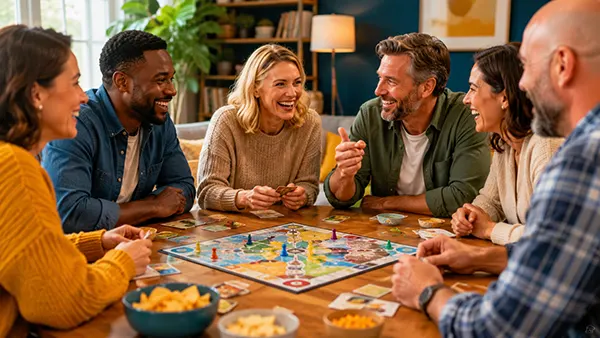
A casual board game can seem like a small thing: a box on a table, a handful of pieces, a few rules and an evening without much planning. Yet in many neighbourhoods, especially in busy towns and cities, small shared moments are often the difference between recognising a face in the hallway and actually knowing the person behind the door. By 2026, board games have become more than a nostalgic pastime. They are part of a wider return to slower, face-to-face leisure, where people look for simple ways to talk, laugh and build trust without needing a formal event. This article looks at how one unplanned game between neighbours can change the atmosphere of a building, a street or a small community.
Why a Simple Board Game Can Break the Silence Between Neighbours
Modern neighbourhood life often creates a strange kind of distance. People may live only a few metres apart, pass each other near the lift, share the same entrance or hear the same rain against the windows, yet still know almost nothing about one another. Work schedules, remote jobs, family responsibilities and the habit of doing everything through a screen can make casual conversation feel less natural than it once did. A board game changes that setting because it gives people a shared reason to sit together without forcing them into personal questions too soon.
The strength of a board game is that it creates gentle structure. Instead of asking neighbours to socialise from nothing, it gives them a task: take a turn, move a piece, draw a card, make a decision, react to a surprise result. This removes much of the awkwardness that often appears when people are meeting properly for the first time. Conversation grows around the game rather than being demanded by it. Someone comments on a clever move, another laughs at a mistake, and slowly the room feels less formal.
This is one reason board games remain relevant in 2026, despite the huge growth of digital entertainment. They offer a form of leisure where people are present in the same space and can read each other’s tone, humour and reactions. The game does not need to be complex. In fact, simpler games often work better for neighbours because they allow everyone to join without long explanations. The point is not to prove skill, but to create a relaxed setting where people feel safe enough to talk.
The Social Power of Low-Pressure Play
Low-pressure play matters because most neighbourly relationships begin with caution. People usually do not want to seem intrusive, too eager or too familiar. A board game gives everyone permission to participate at the same level. The retired teacher, the new tenant, the parent with little free time and the student living away from home can all sit at the same table and follow the same rules. That sense of equality is important because it softens the usual barriers created by age, profession, income or background.
Chance-based elements also help. When a game includes dice, shuffled cards or unpredictable outcomes, nobody controls the whole evening. A lucky turn can make the quietest person smile. A poor roll can make everyone laugh without anyone being singled out unfairly. These small moments of shared reaction help people feel less like strangers. They also create short stories that can be remembered later: the neighbour who won by accident, the person who misunderstood a rule, the sudden comeback nobody expected.
Another useful feature is that board games allow silence without discomfort. In ordinary conversation, a pause can feel heavy. Around a game, pauses are natural because people are thinking, counting, choosing or watching the next move. This makes the setting easier for people who are shy, new to the area or less confident in conversation. They can participate through the game first, and speak more when they are ready.
How One Unplanned Game Can Turn Strangers Into Familiar Faces
Imagine a rainy Saturday evening in a shared building. A power cut, a delayed delivery, a cancelled plan or a simple invitation in the corridor brings a few neighbours together in a common room or someone’s kitchen. A board game is taken from a shelf because it is available and easy to set up. At first, the atmosphere is polite. People introduce themselves by flat number rather than by personality. They speak carefully, trying not to take up too much space.
As the game begins, the tone changes. The neighbour who seemed reserved explains a rule clearly. Another admits they have not played anything like this since childhood. Someone makes tea. Someone else brings biscuits. These details may appear ordinary, but they are often what turns a meeting from practical to human. The board on the table becomes a centre point. People no longer stand at the edge of conversation; they lean in, follow the game and react together.
By the end of the evening, the neighbours may not have become close friends, and that is not the aim. What changes is recognition. A person who was once “the man from upstairs” becomes Daniel, who is good at strategy but terrible at remembering whose turn it is. “The woman near the entrance” becomes Priya, who works shifts and knows the best local bakery. These details make future encounters easier. A greeting in the hallway feels natural. A short conversation near the bins no longer feels forced.
Why Shared Leisure Builds Trust More Naturally Than Formal Meetings
Formal residents’ meetings can be useful, but they often happen because something is wrong: repairs, noise, parking, service charges or building rules. This means neighbours may first meet one another in a mood of complaint or negotiation. Shared leisure creates a different starting point. A board game evening is not about winning an argument or solving a problem. It is about spending time in a way that allows people to see each other as individuals before any difficult issue appears.
Trust rarely arrives through one large gesture. More often, it grows through repeated small signs: someone listens, someone waits their turn, someone explains a rule fairly, someone laughs without making another person feel foolish. Board games make these behaviours visible. They show patience, humour, competitiveness, generosity and honesty in a low-risk setting. Even a minor disagreement about a rule can become useful if people resolve it calmly.
This kind of trust can have practical value. Neighbours who know each other are more likely to exchange useful information, notice when someone may need help, share local recommendations or cooperate during minor problems. A board game does not repair a broken community by itself, but it can create the first link. Once people have sat together in a friendly setting, it becomes easier to ask a simple favour, offer support or suggest another gathering.

What Board Games Reveal About Local Community Life in 2026
In 2026, many people are reassessing how they spend their free time. Digital tools are useful, but they can also make leisure feel fragmented. A person may communicate with dozens of people in a day and still feel disconnected from those who live nearby. Board games answer a very old need in a modern setting: the need to be in the same room with others, doing something shared, understandable and human.
The continued interest in board games also reflects a broader change in how people think about community. Not every social connection has to be deep or demanding. Sometimes a healthy neighbourhood is built from modest relationships: knowing names, exchanging greetings, recognising routines and feeling that the people around you are not complete strangers. A board game suits this kind of connection because it does not require people to reveal too much too quickly.
Another reason board games work well in local communities is their flexibility. They can fit into a family evening, a residents’ room, a small café, a library event or a kitchen table. They do not require expensive equipment, specialist knowledge or a long journey. For mixed-age groups, they can be especially useful because they create a shared activity where children, adults and older neighbours can all take part in different ways.
How to Make a Neighbourhood Game Evening Welcoming and Practical
A successful neighbourhood game evening should feel easy to join. The invitation can be simple: a note in a shared entrance, a message in a residents’ chat or a casual mention after a brief conversation. It helps to be clear about the time, place and expected length, because people are more likely to come when they understand the commitment. Two hours is often enough for a first gathering. It gives the evening shape without making it feel like a major obligation.
The choice of game is important. For a first meeting, the best option is usually a game with clear rules, short turns and room for conversation. Very complex games can exclude newcomers, while overly childish games may not suit the group. Cooperative games can work well because they place everyone on the same side, but light competitive games can also be effective if the tone remains friendly. It is wise to have two or three options available so the group can choose what feels right.
Small practical details can make the evening more comfortable. Seating should allow everyone to see the board and each other. Drinks and simple snacks help, but they should not become the main responsibility of one person. The host or organiser should explain that no experience is needed and that people can watch before joining if they prefer. This matters because the real purpose is not to complete the game perfectly. The purpose is to create a setting where neighbours can speak, listen and leave with a warmer sense of the people living around them.